










August 7, 2026
Hi Anne
 
Print Icon
 
https://stratus.campaign-image.eu/images/20065281358/inkcanva_32883000021538789.png

7 August 2026

Follow us: 

Click here for details of how to join our members WhatsApp group.


The DSPT is not just about Compliance

It’s about protecting your organisation, your staff, and the people you support.


Hopefully, you managed to publish your annual Data Security and Protection (DSPT) self-assessment in time for the 2025/26 toolkit year (V8) deadline 30 th June? You can check your DSPT publication history, log into your account or register here  - you’ll need your NHS ODS Code.


Deadlines aside, while mandatory compliance is crucial to fulfil your regulatory, contractual, and sector requirements, I think we need to remember that the DSPT is more than just a tick box exercise that you undertake just once a year, it’s a safeguard for your organisation.


To help you develop strong, effective policies and procedures, we’ve created a Policy Masterclass Workshop Series. These sessions provide a practical deep dive (and interactive templates you can download) into some of the most important elements of the DSPT, helping you move beyond compliance and strengthen your overall approach to information governance.


We’ll begin by exploring two of the most valuable documents, your Information Asset Register (IAR) and the Record of Processing Activities (RoPA).


Together, these documents provide the foundation for understanding, managing, and protecting the information your organisation holds, where it is stored, how it is used and who has access to it. This visibility is essential for managing risk, responding to incidents, and ensuring information is handled appropriately.


You could face regulatory scrutiny for example, if the ICO investigates a complaint or breach and finds that you cannot demonstrate accountability or maintain adequate records of processing, this may be viewed as a failure to meet your data protection obligations under UK GDPR.


Having a robust IAR and RoPA in place is not just about compliance; it's about understanding and protecting one of your organisation's most important assets: its information.


AI risks and CQC


Focusing on real operational value, safety, and compliance (CQC/DSPT aligned) we’ve looked at the risks associated with unregulated use of Artificial Intelligence (AI).  In this post, I am focusing on how AI can be used safely and efficiently within Social Care, but first a note from CQC.


As AI becomes increasingly embedded in health and social care, the CQC has acknowledged its value as an innovative tool. That said, they are clear that its use must always be purposeful - enhancing outcomes for people receiving care and supporting more effective, efficient service delivery.


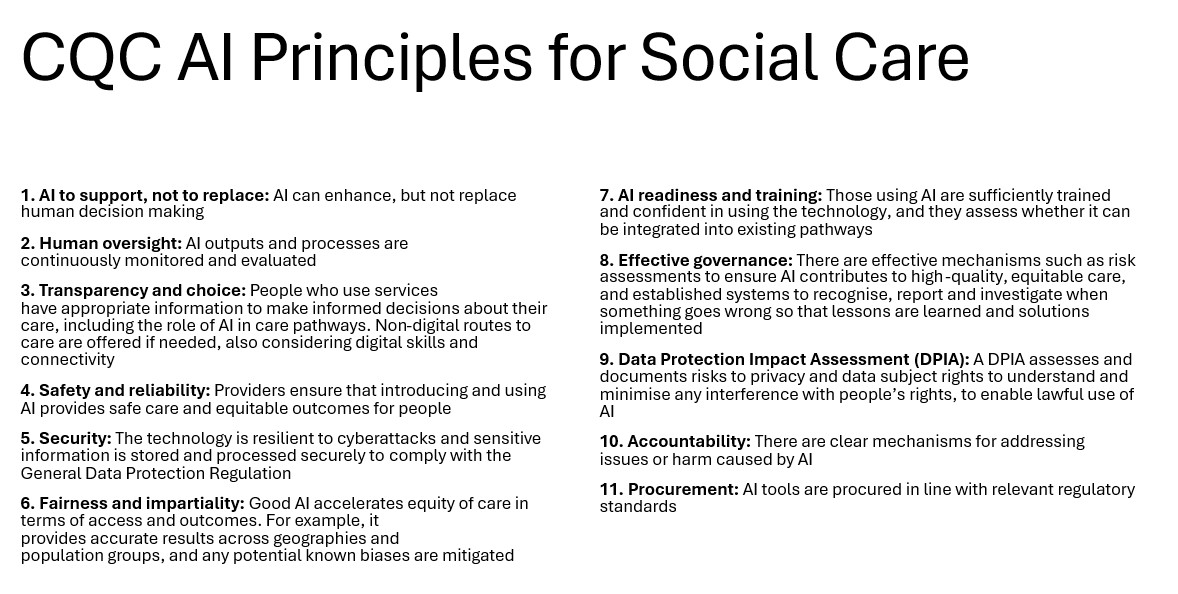
You can refer to CQC principles and how they relate to Data Security and Protection (DSPT)   signposting evidence required in the document linked below, and/or refer to Artificial intelligence in health and social care: CQC's role, expectations and plans - Care Quality Commission


https://stratus.campaign-image.eu/images/32883000027229003_zc_v1_1784106193923_cqc_ai_principles.jpg

These CQC AI expectations fit almost entirely within the DSP Toolkit (which is based on 10 National Data Guardian (NDG) standards) 4, 5, 6, 7 and with the strongest alignment to 5 Risk Management and 10 Safe, Effective Systems.


5 Practical, low risk ways you can start using AI today


1.  Draft Notes, Emails and Reports – use it for case notes, assessments, funding requests, emails to providers or families, meeting summaries


Paste a rough idea or bullet points into an AI tool, say Copilot, and ask it to “make it professional”, “shorten”, or “improve tone” i.e., “Write a polite follow-up email checking on a delayed medications prescription”


Ai is already used to generate care plans and notes to reduce admin workload as it frees time for frontline care.


⚠️  Low risk? – if you review/edit before saving to an actual care record and you don’t paste any identifiable personal data


2.  Summarise Assessments and long documents (Safeguarding reports, Care Act assessments, Policy documents, Meeting notes)


Paste notes, reports, or meeting transcripts and ask for key points, action items, or a short summary i.e., “Summarise the following in 5 bullet points and highlight any actions” or “Summarise key risks and recommended actions from the following assessment” (Don’t attach the document as it may contain personal identifiable data but copy and paste text instead)


AI helps staff quickly interpret large volumes of information and improve workflow efficiencies.


⚠️  Low risk? If you still read the output and apply professional judgement and always sense-check outputs for accuracy or bias


3.  Turn Conversations into Action Plans (use it for MDT meetings, reviews with service users, team discussions) i.e., “Create a simple action plan with responsibilities and deadlines”


⚠️  Low risk?  AI suggests structure only – final care decisions must stay human-led


4.    Improve communications and everyday writing


a.  Rewriting letters in plain English (i.e., removing jargon) i.e., “Rewrite this letter in simple, clear language suitable for a service user”


b.  Creating easy-read versions


c.  Drafting FAQs or guidance


AI is used to simplify communication and support accessibility in social care contexts.


⚠️ Low risk?  If you still read the output and apply professional judgement and  
always sense-check outputs for accuracy or bias


5. Create Training and Awareness Materials


Use AI to generate:

·  Quiz questions

·  Revision cards

·  Workshop activities

·  Frequently Asked Questions


Example: "Create 10 multiple-choice questions on GDPR for care workers."

AI speeds up content creation and reduces preparation time


⚠️ Low risk? No risk.


Simple Reminder: THINK Before Using AI


T – Think about the information you're entering & keep data safe
H – Hide personal and confidential data
I – Inspect AI outputs for accuracy, biases or hallucinations
N – Never rely solely on AI decisions use human oversight
K – Keep to organisational policies


AI can save time and improve productivity, but it should always be used safely, securely, and with the people you support at the centre of every decision.


The Bottom Line


The safest and most effective starting point for using AI in your organisation is to use it for admin, writing, and thinking support – not decision making .


Interested in finding out more about AI?


We have a forthcoming virtual FREE 1 hour introduction training session


3 September 2026

11.00 – 12.00 NOON


Find out more and book yourself onto the  AI in Adult Social Care: Opportunities, Hidden Risks and Safe Management  webinar


Resources Library


Coming up......


* Is your business continuity plan ready for a digital disruption?

* “AI myths vs facts in social care”

* New – FREE Digital Health Checks


Carol Leach  is a Digital Project Manager within WMCA's digital team. Carol and the team can be contacted via  enquiries@wmca.digital

https://stratus.campaign-image.eu/images/32883000027229003_zc_v1_1780645848212_carol.jpg
     
https://stratus.campaign-image.eu/images/20065281358/inkcanva_32883000021538789.png
   

Need Help completing the DSPT?

https://stratus.campaign-image.eu/images/32883000027229003_zc_v1_1752513858450_wme___wm_social_care_international_recruitment_logo.jpg

West Midlands Care Association is your local  Better Security Better Care  support organisation, offering free online resources, workshops and one-to-one support to help CQC registered providers complete the DSPT.


We also have a new offer, a free onsite, in-person  Digital Health Check .


Click the button for more info.


Our Partners

https://stratus.campaign-image.eu/images/32883000027229003_zc_v1_1746705362615_quality_of_care.png
https://stratus.campaign-image.eu/images/32883000027229003_zc_v1_1746704926641_grace_cares_newsletter_ad.png
https://stratus.campaign-image.eu/images/32883000027229003_zc_v1_1724925105724_pcs.png
https://stratus.campaign-image.eu/images/32883000027229003_zc_v1_1724925176215_wm_legal.png
https://stratus.campaign-image.eu/images/32883000027229003_zc_v1_1724925188856_hcr_law.png
https://stratus.campaign-image.eu/images/32883000027229003_zc_v1_1724925254719_spectrum.png
https://stratus.campaign-image.eu/images/32883000027229003_zc_v1_1776175925775_pharmacy_xpress_banner_(2).png
https://stratus.campaign-image.eu/images/32883000027229003_zc_v1_1746705362615_quality_of_care.png
https://stratus.campaign-image.eu/images/32883000027229003_zc_v1_1776175932650_syncurio_tile_(002).png
https://stratus.campaign-image.eu/images/32883000027229003_zc_v1_1724925164254_citation.png
https://stratus.campaign-image.eu/images/32883000027229003_zc_v1_1776175973493_delphi_email_banner_(002).png
https://stratus.campaign-image.eu/images/32883000027229003_zc_v1_1746704926641_grace_cares_newsletter_ad.png
     

West Midlands Care Association  enquiries@wmca.care  01384 943000

https://campaign-image.eu/zohocampaigns/32883000002246595_1611831926057_wmca_logo.jpg
https://stratus.campaign-image.eu/images/32883000027229003_zc_v1_1753716101726_wmca_main.png
https://campaign-image.eu/zohocampaigns/32883000002246595_1611831926218_caa.jpg

“This support is part of the Better Security, Better Care programme, funded by the Department of Health and Social Care to support data and cyber security across the adult social care provider sector.”


This email was sent by news@wmca.care to an@wmca.care
West Midlands Care Association | Globe House Park Lane Halesowen B63 2RA
West Midlands Care Association 
Authorized representativeCEO  |  Email addressenquiries@wmca.care  |  Phone01384943000

Share

August 11, 2026
The Casey Commission
August 6, 2026
Introducing Advance Worcestershire
August 6, 2026
Could a Missing Power of Attorney put your Service at Risk?
August 4, 2026
Improving Care and Promoting Independence for People Living with Sight Loss
August 1, 2026
16 October 2026 6.30pm - 11.00pm Merry Hill
July 31, 2026
ADASS Updates DoLS Priority Tool
July 29, 2026
Baroness Casey launches the Big Conversation on Care with the public 
Show More